
Fire protection hand calcs, with every step shown
An offline calculation aid for Android that shows the numbered hand-method steps with your numbers filled in as you type, so you can follow the method instead of trusting a hidden answer.
Early build
On Google Play as an early build for Android phones. Its calculators run placeholder arithmetic, so read the limits before any result.
Free: no account, no ads, no in-app purchases.

What Fire Hydraulics Toolkit is
Fire Hydraulics Toolkit is a free Android calculation aid by Sonicon Software for fire-protection designers, plan reviewers and trainees. It covers four water-side hand calculations in US customary units with SI equivalents, shows every hand-method step with your numbers, and works offline. Results must be reviewed by a qualified engineer.
An early build: read this first
Placeholder arithmetic
The calculators, steps, library and export all work, but nine of the step formulas are stand-ins for the NFPA reference equations, and every result depends on at least one of them. A margin can even point the wrong way. Every calculator, PDF and CSV says so. Don’t use the numbers for design or study yet.
The app shows this notice on every calculator: “Placeholder arithmetic: NFPA reference equations are not loaded yet. Don't use these numbers for design.” Read what placeholder arithmetic means and the terms for this app.
Four hand calculations
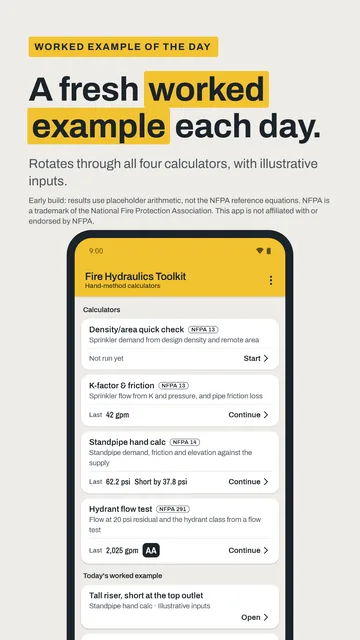
Fire Hydraulics Toolkit has four calculators: a density/area quick check and K-factor and friction for sprinklers, a standpipe hand calc, and the hydrant flow test. Each takes the readings or design values you would use on paper and lists the steps from those inputs to the result, filled in as you type.
Density/area quick check NFPA 13
From the design density and remote area to the demand flow with hose allowance and the required pressure. Enter an available supply pressure to compare it with the requirement.
K-factor and friction NFPA 13
Sprinkler flow from the K-factor and pressure, and friction loss along a pipe from its inside diameter, Hazen-Williams C factor and length.
Standpipe hand calc NFPA 14
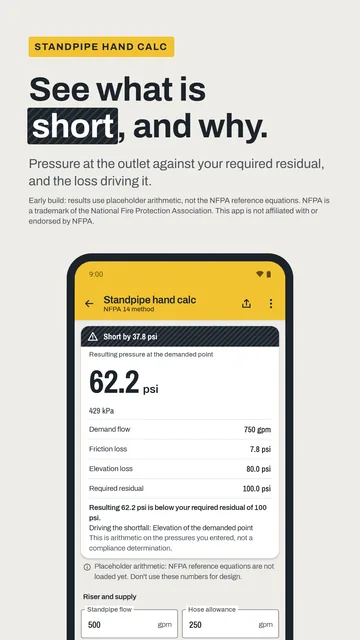
Standpipe flow plus hose allowance, friction and elevation loss, and the resulting pressure at the demanded point against your required residual, naming the input it reads as driving a shortfall.
Hydrant flow test NFPA 291
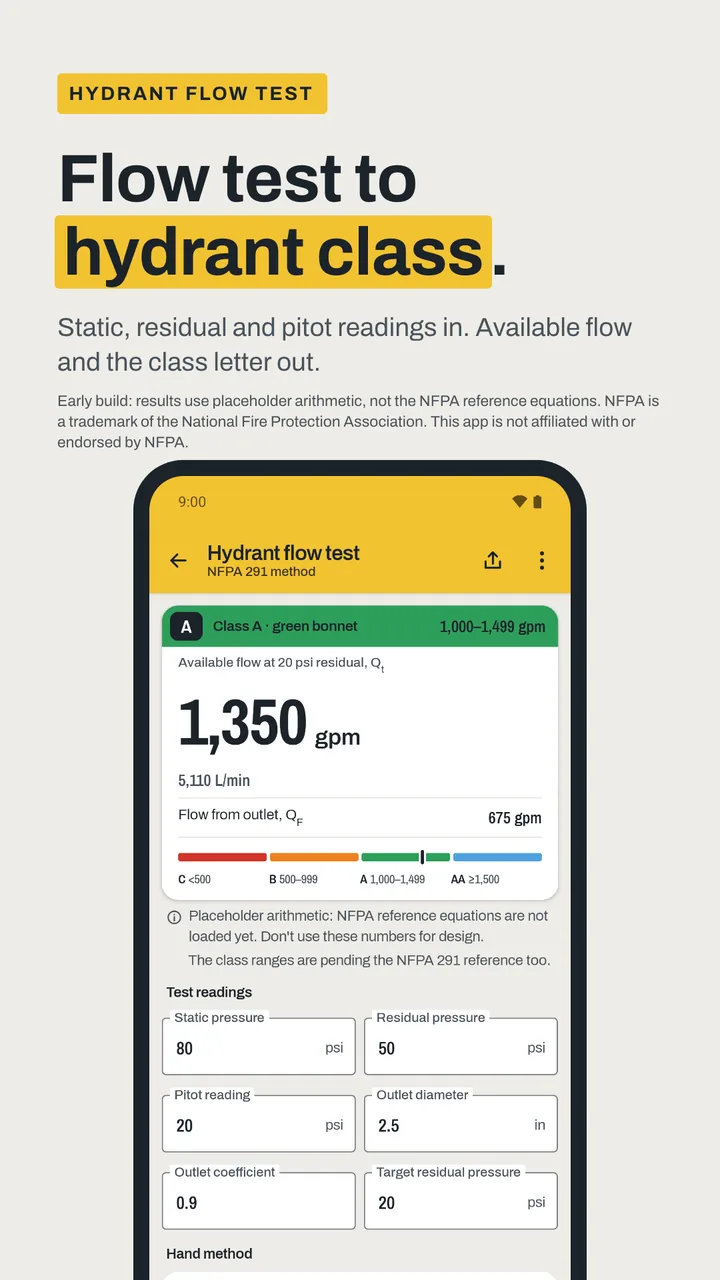
From static, residual and pitot readings and the outlet size to the flow from the outlet, the available flow at 20 psi residual and at your own target, and the hydrant flow class with its letter.
The steps are the product
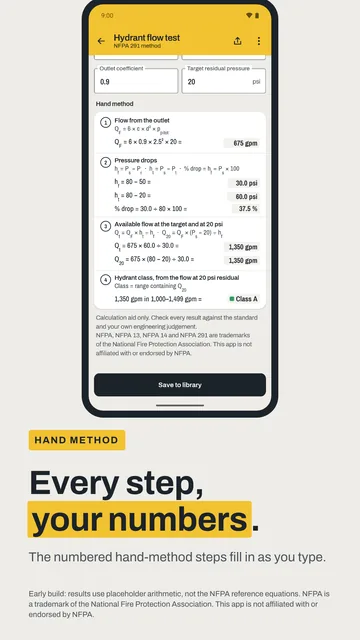
Under every result sits a numbered Hand method list. Each step shows its formula, the same formula with your numbers substituted, and the value, and it fills in again as you change an input. A formula reference screen explains each symbol and the input it comes from, so you can check the method line by line.
Hand method · Hydrant flow test
- Flow from the outletPitot reading, outlet diameter and coefficient
- Pressure dropsStatic to residual, static to your target, and the percent drop
- Available flow at the target and at 20 psiScaled from the tested flow
- Hydrant classFrom the flow at 20 psi residual
The hydrant flow test’s seven numbered steps, grouped in four. In this build the outlet flow and the flows at the target and at 20 psi use stand-in formulas; the pressure drops are real subtractions.
Hydrant bonnet colours, with the letter
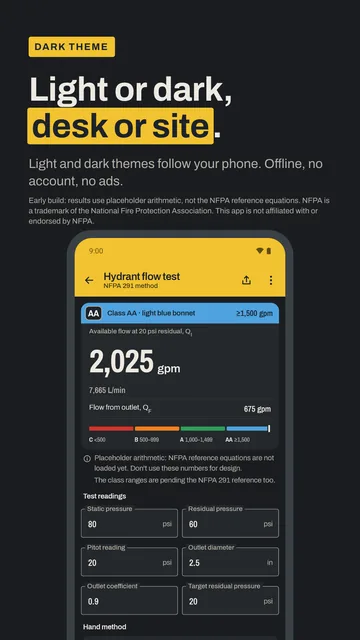
The hydrant flow test result band takes the colour of its flow class on the hydrant bonnet colour scale, and the class letter is printed on it, so the colour never stands alone. On the density/area and standpipe screens the band shows the margin against the supply or required residual you enter, hatched when it is short.
Hydrant flow class scale
- C, red bonnet
- B, orange bonnet
- A, green bonnet
- AA, light blue bonnet
C red, B orange, A green, AA light blue, each with its letter. The class comes from a placeholder flow at 20 psi in this build, so treat it as illustrative.
Keep it, re-run it, hand it over
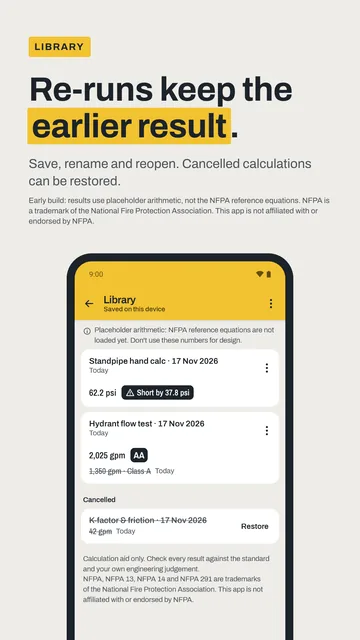
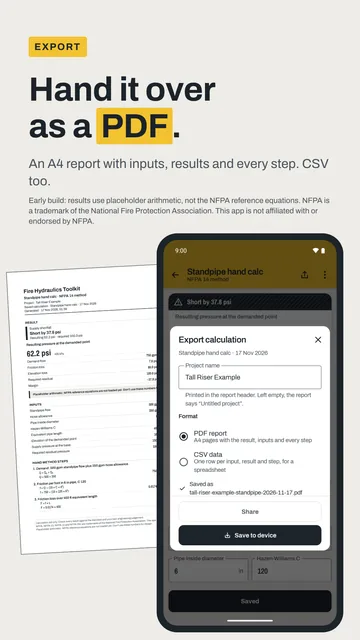
Save a calculation to the library, rename it and open it again later. Re-run it with new readings and the earlier result stays with it. Save or share any calculation as an A4 PDF or a CSV file with your inputs, results and steps, and an optional project name for the report.
- A worked example each day: the home screen offers one of 16 worked examples each day, rotating through all four calculators. They use illustrative inputs, not real projects.
- Cancel without losing it: a cancelled calculation moves to Cancelled, where you can restore it; Remove cancelled deletes them after a confirmation.
- Desk and site: light and dark themes follow your phone, built for an office desk and for glare on site.
- Your inputs come back: each calculator keeps what you typed and restores it the next time you open it.
- A quick tour: the first launch opens a hydrant flow test sample with three short tips you can skip or replay.
What happens to your data
Fire Hydraulics Toolkit has no internet permission, account, ads or analytics, and we collect nothing from it. Your inputs and library are kept in the app, and Android may copy them to your Google account backup and to a new phone. Exports go only where you save or share them. Read the full privacy policy.
Screens from the app
Screenshots of the early build. Every number in them is placeholder arithmetic.
More engineering calculators from Sonicon
Critical Velocity Calculator: tunnel critical velocity and required airflow for smoke control, with every iteration shown.
Smoke Control Toolkit: atrium smoke control and stairwell pressurization calculations, with every step shown.