
How Kite String works
Kite String is a 2D kite-flying game for Android phones by Sonicon Software. Here is how the flight, the pench, the rooftops and the rewards work, and where the game's limits are.
One thumb: hold and let go
Kite String has one control: hold anywhere on the sky. Holding pulls the string, so the kite darts the way its nose points, faster the longer you hold. Letting go gives line: the kite slows and its nose turns. A long hold strains the string until it snaps. Timing each pull to the nose is the whole skill.
- Khench (hold) the string tightens and the kite darts.
- Dheel (let go) the kite drifts with the wind and turns.
- Strain the string quivers and the tension bead slides toward the kite; let go before it snaps.
- Crest a gust is warned first; let go as it crests for a free boost and a gold ribbon on the tail.
A keyboard's Space key or a D-pad's centre button also holds. No buttons or arrows are drawn while you fly.
Five places in the sky
Over the parapet, Rooftops, With the flock, High wind and Top of the sky. They are places, not ranks, and the camera follows your kite through them.
A run, from Ready to Results
A rooftop or Daily run lasts until sunset, 75 seconds of flight, or 90 against a Mohalla champion, unless your string snaps or is cut first. You climb through five places in the sky, collect chikki, catch gusts and meet rival kites. Results show up to three stars, chikki, XP and sometimes a Kodi.
Star one is for reaching sunset; stars two and three are the rooftop's own goals, such as cutting a rival or flying with the flock. A snap or a cut still pays chikki and XP and keeps any kite you wrapped. Fly again from Results.
The pench
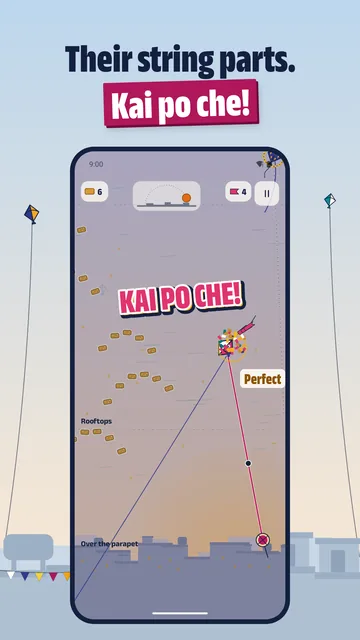
When your string crosses a rival kite's string, a pench opens. Knots travel down the rival's string to the crossing: a filled knot means hold, an open knot means let go. Each clean beat cuts a strand of their string; each miss frays a strand of yours. If theirs parts first, Kai po che! If yours does, the run ends.
When their string parts, the kite drifts slowly down and the rooftops cheer. Steer your string under it to wrap it (lapet), and it joins your kites. Holding on a filled knot never builds strain, so a hold knot can't snap your string. Cutting here is a festive contest drawn in paper and string; no person is drawn, and birds only scatter.
Rooftops, the Daily sky, the Endless climb and Uttarayan
Rooftop map
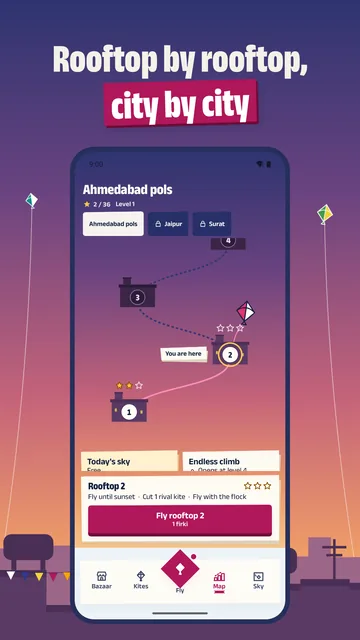
Three cities, starting with the pols of Ahmedabad, then Jaipur and Surat. Every rooftop has its own course to learn and three stars to earn: reach sunset, then meet its two goals.
Mohalla champion
The twelfth rooftop of each city is a two-phase pench against the neighbourhood's champion.
Daily sky
One course for each date, the same for everyone and free to fly. Your Daily flights fill this month's sky.
Endless climb
A new course every run: see how high you can climb before the string runs out. Opens at level 4.
Uttarayan days
On 14 and 15 January, by your phone's date, every mode flies in a night sky with tukkal lanterns, chikki rewards are doubled, and the Uttarayan Tukkal kite is yours once a year.
Chikki, moti, firki and Kodi
Chikki, a sesame-brittle bar, comes from runs, cuts, missions and Kodi, and pays for upgrades. Moti, a pearl, is rarer and earned only. The firki is your energy, up to five. A Kodi is a timed bundle of kites. Every reward is recorded once, so a repeated tap or a closed app never grants it twice.
- Bazaar a free gift once a day, and three gear offers priced in chikki or moti that change at your midnight.
- Missions three a day, with one free swap, and a weekly milestone at 15 missions.
- Rooftop streak seven days, with one calm day each week applied for you, so a single missed day doesn't reset it.
Kites, manja and firki
Four kites, Chil, Ghensiyo, Chaand-tara and Pari, in four cloths: Plain, Bandhani, Zari and Shahi. Upgrade kites, manja (Sharp, Strong, Length) and firki with duplicate cards and chikki; the hangar explains each level in plain words. Fabrics never change a stat.
Fair by seed
Every course comes from a seed, and the flight runs at a fixed 120 steps a second whatever your phone's frame rate. The same course and the same touches give the same flight. A rooftop's course stays the same, so it can be learned, and the Daily sky is one course for each date, the same for everyone.
Inputs and limits
- A rooftop or Daily run lasts until sunset: 75 seconds of flight, 90 against a Mohalla champion, unless your string snaps or is cut first. The clock waits while the game is paused.
- You hold at most five firki, and one comes back every 15 minutes. A rooftop or Endless run uses one at your first hold. Leaving from the Ready screen is free; a run you abandon is not refunded.
- Your parapet holds four Kodi, and one opens at a time: Plain 3 hours, Bandhani 8, Zari 12, Shahi 24. A Kodi won while all four slots are full turns into chikki, and the results say so.
- Moti speed up a Kodi (1 moti for every 10 minutes left) or buy one revive per run, for 10 moti, on rooftops and in the Endless climb.
- Only today's Daily sky can be flown, by your phone's local date. The first finished flight of the date earns its rewards; a flight that crosses midnight counts for the date it started.
- A rooftop opens once the one before has a star. Jaipur opens after the Ahmedabad champion and level 6, Surat after the Jaipur champion and level 12. The Endless climb opens at level 4.
- Three missions a day, with one free swap; a weekly milestone at 15 missions. The rooftop streak runs seven days, with one calm day each week applied for you.
- The same course and the same touches give the same flight. If an update changes how courses are made, courses change with it.
- Uttarayan days are 14 and 15 January by your phone's date.
- No online play, leaderboards or ghosts. Single player only.
- Nothing goes to cloud backup. On Android 12 and later, setting up a new phone from your old one can move your game across. Uninstalling the app, or clearing its storage in Android settings, deletes it; there is no reset inside the app.
- Android phones running Android 8.0 or later. English only.
Your rooftop is waiting.