
Method
How Nakshatra works out your kundli and panchang
Nakshatra is a free Android app by Sonicon Software for Vedic astrology in Hindi and English. From your birth date, time and place it works out a North-Indian kundli with Vimshottari dasha, a daily rashifal from your moon sign, a daily nakshatra card and the day's panchang. Every calculation runs on the phone, and the app has no internet permission.
This page lists each method and where it can differ from other software.
Birth details and place
You enter a name, birth date, birth time and birth place once. The place comes from 1,503 Indian places stored in the app, or from a latitude, longitude and time zone you type. The same place is used for the kundli, the daily reading and the panchang, so all times are for that place.
Historic Indian clock offsets come from the time-zone data built into Android's Java libraries for Asia/Kolkata. The app is designed and tested for births from 1900 to 2100.
The kundli
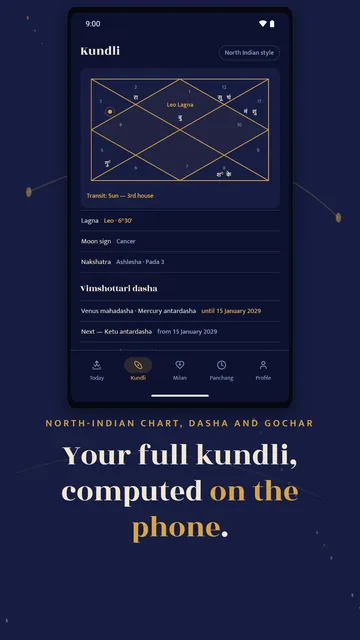
Nakshatra computes tropical positions on the phone and subtracts the Lahiri (Chitrapaksha) ayanamsa to get sidereal ones. The lagna comes from your birth time and place. Houses are whole-sign: the lagna's sign is the first house. Rahu and Ketu use the mean lunar node. The chart is drawn in the North-Indian style.
Sun: a truncated VSOP87D series. Moon: ELP-2000/82 as truncated in Meeus, Astronomical Algorithms. Mercury to Saturn: Paul Schlyter's orbital elements. The kundli also marks the house the Sun is passing through today.
Only the birth chart (D1) is drawn; there are no divisional charts such as the navamsa.
Vimshottari dasha
The dasha starts from the Moon's nakshatra at birth: the balance of the first period is the part of that nakshatra the Moon has still to cross. Periods follow the 120-year Vimshottari order, with years of 365.25 days. The app shows the running mahadasha and antardasha with dates, and the next antardasha.
Daily rashifal and its three tags
Each morning Nakshatra counts where the planets are from your moon sign at sunrise at your birth place. It picks one of Jupiter, Venus, Mercury or the Moon by a fixed rule that favours houses traditionally read as good, and shows the line written for that planet and house. Same chart and day, same reading.
Lucky colour is the colour of the weekday's planet, the same for everyone on that weekday. Lucky number comes from the day's nakshatra. Lucky hour is the first hora after sunrise ruled by Jupiter, Venus, Mercury or the Moon. Sun, Mars, Saturn, Rahu and Ketu are not chosen for the line.
The line is text written in advance for each planet and house. It starts from your moon sign only, not from your whole chart.
The daily card and streak
Each day the app turns over one of the 27 nakshatra cards. The card follows a fixed 27-day order, so everyone sees the same card that day; it is not the Moon's nakshatra. Opening it adds it to your collection and marks the day. One missed day in a rolling seven days is covered by a freeze.
Panchang
Sunrise and sunset are when the Sun's upper edge meets the horizon, with standard refraction, at your birth place. The tithi and nakshatra running at sunrise name the day, with their end times. Rahu kaal is one of eight equal parts of daylight, set by weekday; abhijit is the middle of fifteen day muhurtas.
Example: Jaipur, Friday 13 November 2026
Output of the app's engine for the demo birth place. Times in IST.
- Sunrise
- 06:44
- Sunset
- 17:37
- Rahu kaal
- 10:49–12:10
- Abhijit
- 11:49–12:32
- Tithi at sunrise
- Shukla Chaturthi, until 20:42
- Nakshatra at sunrise
- Mula, until 17:16
Hora follows the Chaldean order of the planets, starting from the weekday's planet at sunrise. Choghadiya divides daylight and night into eight parts each. The panchang page counts down to the next rahu kaal and choghadiya.
Inputs and limits
Nakshatra's results depend on its settings and on what you enter. It uses one ayanamsa, one house system and the mean node, draws the birth chart only, and times the panchang for your saved birth place. Other software can show a different lagna, dasha dates or planet degrees. Each limit is listed below with figures from the app's engine.
| Part | What it means |
|---|---|
| Ayanamsa | Lahiri (Chitrapaksha), 23°51′11.5″ at J2000, advanced by the IAU 2006 precession rate. AstroSage's N.C. Lahiri setting runs about 0.016° higher, so dasha dates can differ by about a week. For the demo birth, the Venus mahadasha runs from 17 March 2010 to 17 March 2030 in Nakshatra, and from 24 March 2010 to 24 March 2030 in AstroSage. |
| Houses and charts | Whole-sign houses, drawn North-Indian style. The birth chart (D1) only; no divisional charts such as the navamsa. |
| Planet positions | Rahu and Ketu are at the mean node. Jupiter and Saturn differ most from AstroSage: for the demo birth, by 0.15° and 0.24°. Signs and houses agree there for all nine grahas, but a planet within about a quarter of a degree of a sign or nakshatra edge can land differently in other software. |
| Birth time | The app needs a birth time; it has no unknown-time mode. For the demo place and date the lagna moves about 0.22° per minute of birth time, so a few minutes' error can change the lagna near a sign edge. |
| Dates | Designed and tested for births from 1900 to 2100. The form accepts other dates, but outside 1900 to 2150 the clock correction (delta T) reuses the nearest tabulated range. |
| Places | 1,503 Indian places can be searched offline. Elsewhere, type the latitude, longitude and an IANA time zone such as Europe/London. |
| Which place | The panchang and the daily reading use your saved birth place, not where you are now; the app has no location permission. Born in Jaipur and living in Mumbai, you see Jaipur's sunrise, rahu kaal and choghadiya. |
| Panchang times | Shown to the minute. On the Jaipur test days, sunrise, sunset and tithi and nakshatra end times are within 2 minutes of Drik Panchang; moonrise is within 9 minutes. |
| Rashifal | From your moon sign only. One line, picked by a fixed rule from Jupiter, Venus, Mercury or the Moon, written in advance; not a reading of the whole chart. |
| Daily card | The same card for everyone that day, in a fixed 27-day order, and not the Moon's nakshatra. On 13 November 2026 the card is Pushya while the Moon is in Mula. |
| Sky events | Full and new moon times; the start of retrograde motion for Mercury to Saturn, to within about a day; and sidereal sign changes, except the Moon's. |
| Readings | Traditional astrology, shown for reflection. Not advice; see the terms notice. |
How it was checked
The app's tests compare its demo kundli with an AstroSage chart for the same birth, and its panchang with Drik Panchang for Jaipur. Sunrise, sunset and tithi and nakshatra end times agree within 2 minutes on the test days, and Jupiter and Saturn differ by up to about a quarter of a degree.
The demo birth is 14 August 1996, 06:42 IST, Jaipur (26.9124° N, 75.7873° E), the app's own demo profile. The comparison is a test of the method, not a claim that any two programs will agree.
Read the method? Try it on your own birth details.